From July to September the Golden Triangle is warm, humid and often wet, but the rain usually comes in showers rather than all day. The landscape turns green and monuments are quieter, though travel can be slower and some outdoor plans need flexibility. Many sights work well in the rain. Wildlife parks and river views are the main things that suffer.
The monsoon reaches Delhi around the end of June or early July and lingers until September. It is the least popular time for visitors, and the reputation is partly deserved. It is humid, the roads can be slow, and a plan made weeks ahead may need to shift with the sky.
It is not a lost season, though. The air is rinsed clean, the hills around Jaipur go green, and the monuments are far less crowded. Here is what to expect honestly, and how we plan around it.
What the weather is like from July to September
The monsoon does not mean constant rain. A typical day is warm and humid, with periods of cloud, and showers that may be heavy but often pass within an hour or two. Some days are mostly dry. Others are grey and wet from morning to evening. The pattern varies from year to year, and no one can promise a dry day on a given date.
Temperatures are lower than the peak of summer, but the humidity makes the air feel heavy, and light clothing dries slowly. In September the rain usually eases and the weather slowly turns toward the clearer months ahead.
Which sights suffer in the rain
Open-air walking is the main casualty. Long visits across sandstone courtyards become muddy or slippery, and a hard downpour can end a visit early. Stone steps at forts and palaces can be treacherous, so shoes with grip matter.
Sunrise and sunset views are the next to go. Clouds often hide the sun, so a Taj Mahal sunrise or a Mehtab Bagh sunset may be flat and grey. Mehtab Bagh sits on the Yamuna floodplain, and in wet years the river rises and the garden or the approach may be affected. We would not plan the day around it in this season.
Wildlife is different. National parks such as Ranthambore are generally closed to safari vehicles during the heaviest part of the monsoon, and the dates are set by the authorities, so check before planning a tiger safari. Tiger sightings are never guaranteed in any season.
If your dates are fixed, check the forecast a few days before each city and keep a quiet backup for each day. Our team in Agra watches local conditions, and can swap a plan the evening before if the weather turns. We would rather change the order than push through a downpour, because a visit made in discomfort is rarely a good one.
Which sights hold up well, or even improve
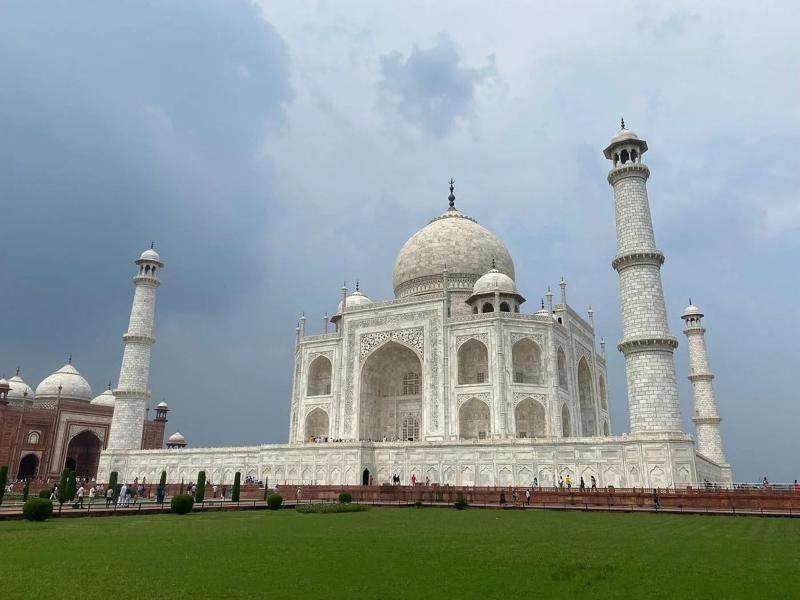
The Taj Mahal itself can look lovely under soft cloud, with the marble glowing against dark skies, and a rain-washed garden is green. Photographers sometimes prefer it to a crisp blue day. A shower may pass while you are inside the mausoleum, where there is shelter.
Palaces, museums and covered halls come into their own. In Jaipur, the City Palace museum rooms and other indoor galleries make good wet-weather stops. Amber Fort and the hills around it are green and often misty, and the setting can be at its best. Delhi's museums, tombs with covered arcades and the old city's covered lanes also work well.
Food, textile and craft visits suit a wet afternoon too. Spending an hour with a block printer or at a workshop is a good way to wait out a shower.
One more point on the Taj Mahal: the marble can be slippery when wet, and the long approach has little cover. Your guide will usually suggest waiting out a heavy shower in a doorway or the nearby arcades, which also gives you a quiet moment to watch the rain fall on the garden.
How we plan a monsoon journey
The plan stays loose. Each city has an indoor option alongside the outdoor one, and your guide and driver choose between them on the day, looking at the sky rather than a fixed timetable. If a morning is wet, the order of the day can flip.
We also allow more time between cities. Heavy rain slows highways, and the drive from Delhi to Agra or Agra to Jaipur can take longer than usual. We build slack into the day so you are not racing the light. The car is air conditioned and you travel with a driver who knows the roads.
Because the guide and driver are yours, you can change your mind. If you would rather skip a muddy ruin and spend longer in a museum, we do that without any fuss.
The case for going anyway
The main argument is quiet. Queues are shorter, rooms are easier to arrange, and sites that are packed in winter feel almost private. The landscape is greener than at any other time of year, and the light after a storm can be beautiful.
It also suits people who have fixed dates, enjoy rain, or want a slower and softer trip. Come with patience and a flexible mood, and the monsoon gives you a different India rather than a worse one.
Travellers who enjoy photography often find that clouds make a more interesting sky than a plain blue one, and wet stone saturates colour in a way that dry stone does not. Carry a cloth to wipe your lens, and keep your camera in a dry bag between stops.
Practical tips and who should wait
Pack a light rain jacket or compact umbrella, quick-drying clothes, shoes with grip and a spare pair of socks. Keep phones and documents in a waterproof pouch. Insect repellent is useful, particularly in the evening.
If your heart is set on a clear sunrise at the Taj, long open-air walks or a wildlife safari, we would suggest October to March. If you want a quieter, greener and slower trip and can accept some weather, July to September can be rewarding. We will tell you honestly which side of that line your plans fall on.
Rain, roads and the rhythm of a monsoon day
Rain affects the road more than the sightseeing. Highways between Delhi, Agra and Jaipur are generally good, but heavy showers slow traffic, and standing water can appear on local roads and in older city lanes. Your driver reads these conditions daily and will tell you if a longer margin is needed.
A useful pattern is to see the main outdoor site early, when showers are less likely in many places, and keep afternoons for indoor visits. Storms often build later in the day, though this is a tendency, not a rule.
If you are flexible about the order of the days and about the odd change of plan, the monsoon is far more manageable than its reputation suggests. If your schedule has no slack at all, we would rather say so now and suggest another season.
People also ask
Does it rain all day in the monsoon?
Can I see the Taj Mahal in the rain?
Are tiger safaris possible in the monsoon?
Is the Golden Triangle dangerous in the monsoon?
Will flights or trains be delayed?
Is the monsoon worth it for photography?
Take it privately
4-Day Private Golden Triangle
Four days with an arrival day in Delhi, then Agra, Jaipur and the drive back.
Golden Triangle for first-timers
Five days for people who have never been to India, with the practical side taken care of.
Agra in one day
A full day in Agra for guests who are staying in the city or arriving early, covering the Taj Mahal, Agra Fort and the riverside tomb of Itimad-ud-Daulah by private car with a licensed guide.
Related guides
- Golden Triangle in Summer: April to June Heat and How the Days Work→
- Golden Triangle in December and January: Fog, Cold Mornings and What to Expect→
- Best Time to Do the Golden Triangle, Month by Month→
- Best time to visit Rajasthan, month by month→
- Ranthambore tiger safari guide: what to expect, and why sightings are never guaranteed→
Tell us when you are travelling.
A short message is enough. We will come back with a plan, personally.
Enquire