Humayun's Tomb is a Mughal garden tomb in Delhi, completed in the 1570s, and it is widely seen as a precursor to the Taj Mahal. Allow about one to one and a half hours, a little more if you add the neighbouring tombs. It is a calm, spacious place and a good first stop in Delhi.
Humayun's Tomb stands in southeast Delhi, beside the Nizamuddin area. It is a UNESCO World Heritage Site and one of the most important buildings in the story of Mughal architecture. It is also one of the easier monuments to enjoy, with wide lawns, long views and a gentler pace than the old city.
This guide gives the history in brief, explains the garden tomb layout, suggests how long to allow and sets out why people call it a precursor to the Taj Mahal.
Who was Humayun, and who built the tomb
Humayun was the second Mughal emperor, the son of Babur and the father of Akbar. His reign was interrupted by exile, and he died in Delhi in the middle of the sixteenth century after a fall. The tomb was commissioned afterward, and it is traditionally credited to his first wife, Bega Begum, also known as Hamida Banu Begum.
The architect is generally named as Mirak Mirza Ghiyas, a Persian, which helps explain the strong Persian influence on the design. Construction went on through the 1560s and the monument was completed in the early 1570s. Exact dates vary by source.
Humayun's life itself was dramatic. He lost his throne to Sher Shah Suri, spent years in exile in Persia, and returned to reclaim Delhi only a short time before his death. His son Akbar went on to build the empire into one of the great powers of its age, and the tomb sits at the start of that story.
The garden tomb layout
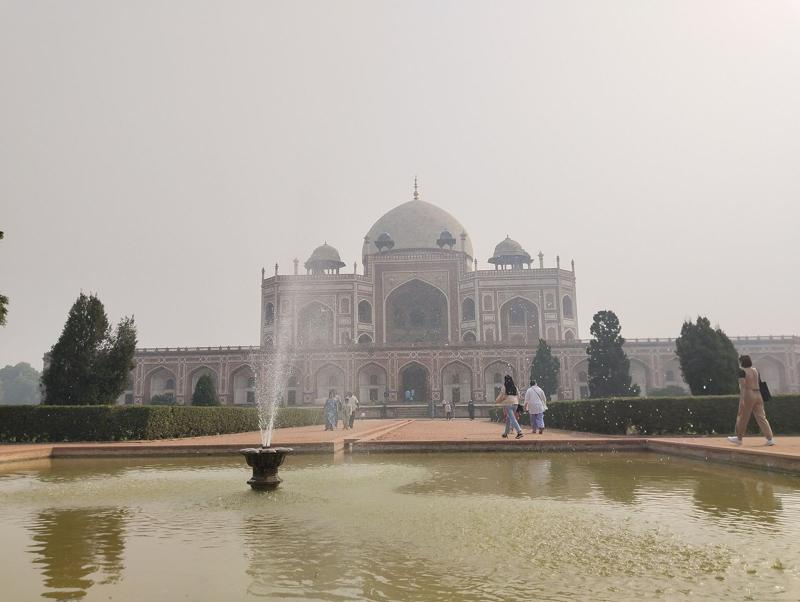
The tomb sits at the centre of a large walled garden laid out on the charbagh plan, a four-part garden divided by raised walkways and water channels. The idea comes from Persian gardens and symbolises the gardens of the afterlife described in Islamic tradition. This was the first large garden tomb of its kind on the Indian subcontinent.
The mausoleum stands on a high platform of arched cells. It is built mainly of red sandstone, with white marble used for the dome and for outlines around the arches and windows. The tomb is octagonal in plan, with a double dome, and it holds Humayun's grave along with those of other royal family members.
Inside the garden walls you will also find smaller structures, including gateways and pavilions. The setting rewards a slow walk around the platform before you go inside.
The scale is easy to underestimate from outside the gates. The garden is large, the platform is high, and the tomb is taller than many visitors expect. Allow time to walk all four sides, since each facade offers a slightly different view.
Why it is called a precursor to the Taj Mahal
Several features that define the Taj Mahal appear here first on a monumental scale. There is the charbagh garden with the tomb at its heart, the high platform, the symmetry, the large central dome with a double shell, and the use of arched recesses on each face. The Taj refines these ideas, and replaces red sandstone with pure white marble.
That is why many writers describe Humayun's Tomb as an ancestor of the Taj, or a rehearsal. It is not a competition. Seeing this tomb first helps you understand what the Taj Mahal is doing, and why it feels so resolved when you arrive at it in Agra.
Because the two are linked, many travellers find that visiting Humayun's Tomb on the Delhi day and the Taj Mahal a day or two later makes both more meaningful.
How long to allow
Allow about one to one and a half hours for the tomb itself. That gives time to walk the garden, climb the platform, look into the chambers and take photographs. A quick visit can be done in less, but this is a place that rewards pausing.
If you want to see the neighbouring monuments, such as the Isa Khan tomb complex, the Barber's Tomb and the Nila Gumbad, add another hour. The nearby Sunder Nursery, a restored garden, is a pleasant extra if you have time.
Restoration and what you see today
The tomb and its gardens were conserved in a major restoration project in the 2000s and early 2010s, led by the Aga Khan Trust for Culture with the Archaeological Survey of India. The work included restoring the water channels, repairing stonework and cleaning the plaster. As a result the monument looks crisp and well kept.
This is also why the surroundings are so pleasant. The gardens are clean, the paths clear and the setting calm, a contrast to the bustle of central Delhi.
Practical tips and fitting it into a Delhi day
The monument is generally open daily from morning until around sunset, and tickets are arranged for you. A security check is part of the entry, and there are some limits on bags. Wear comfortable shoes, since you will be on stone and gravel.
Mornings are best for light and temperature, and the late afternoon glow on the red sandstone is lovely too. Humayun's Tomb pairs well with Lodhi Gardens, India Gate or an afternoon in Old Delhi.
On a private journey, your guide and driver can adjust the order of the day.
Delhi has many layers, from ancient ruins to colonial boulevards, and Humayun's Tomb is a good first taste of the Mughal one. Starting here gives the rest of the trip a thread, which you pick up again at Agra Fort and the Taj Mahal.
What to look for as you walk around
Start outside the main tomb and walk the garden axis slowly. Notice the raised paths, the shallow water channels and the way the building seems to grow larger as you approach. On the platform, look at the contrast between red sandstone and white marble, and at the small details of the jali screens, which filter light into the chambers.
Inside, the central chamber holds the cenotaph, and the surrounding rooms hold other graves. The atmosphere is quiet and cool. Many visitors sit on the platform for a few minutes and simply look out over the garden, which is what the design invites.
Look too at the skyline. Small domed kiosks, called chhatris, and the great double dome give the silhouette that later tombs repeated. Compare it in your mind with the Taj Mahal when you see it, and you will notice how much of its grammar is already here.
People also ask
How long does Humayun's Tomb take to visit?
Why is Humayun's Tomb called a precursor to the Taj Mahal?
Who built Humayun's Tomb?
Is Humayun's Tomb worth visiting?
Can I visit Humayun's Tomb and Old Delhi in one day?
What is the best time to visit?
Take it privately

3-Day Private Golden Triangle
Three days that link Delhi, Agra and Jaipur by road with one car, one driver and a licensed guide in each city.
Golden Triangle for first-timers
Five days for people who have never been to India, with the practical side taken care of.
Delhi and Agra in three days
Three days that begin with a full day in Delhi, move to Agra by road, and finish with the Taj Mahal on the morning of the third day before the drive back.
Related guides
Tell us when you are travelling.
A short message is enough. We will come back with a plan, personally.
Enquire