← All guides

4 Days in India: The Golden Triangle at an Easier Pace

Delhi, Agra, Jaipur · 4 days
Overview

Four days is where the Golden Triangle stops feeling like a race. The extra night goes to Jaipur, and that is where it belongs. With three days you must choose between Amber Fort and the old walled city. With four you can have both, and start neither at a jog.

The shape is one night in Delhi, one in Agra and two in Jaipur. You travel by private car with your own driver, and a licensed guide joins you in each city. Delhi to Agra is about 230 km, three to three and a half hours on the expressway. Agra to Jaipur is about 240 km and roughly four hours of driving, with Fatehpur Sikri on the way. From Jaipur you can fly onward, or drive back to Delhi in five to six hours if your flight home leaves from there. Flights are not included.

The fixed point of the route is the same as ever: the Taj Mahal is closed every Friday. Four days gives you a little more room to adjust, but the adjusting is done in the planning, not on the road. We decide which day you are in Agra before we arrange a single hotel.

Best for. Travellers who want the whole Golden Triangle, including Amber Fort, and who would rather see three cities properly than four cities in a blur. A good first trip to India.

Day by day

How the days go

Day1

Delhi, Mughal and imperial

Your driver and guide meet you in the morning.

  • We give the first half of the day to Old Delhi.
  • The Jama Masjid stands above the lanes of Chandni Chowk, and from there you walk on, using a cycle rickshaw for the longer stretches, to the spice market at Khari Baoli.
  • The food in these lanes is a large part of what the neighbourhood is.
  • A guide who knows which stalls turn over quickly makes tasting it a pleasure and not a risk.
  • In the afternoon the car takes you into New Delhi, the broad, planned city of the early twentieth century.
  • You see India Gate and the ceremonial avenue beyond it.
  • The stop to protect, if the day runs long, is Humayun's Tomb.
  • Built in the 1560s, it is the model the Taj Mahal refined: the same four-part garden, the same central dome on a raised plinth.
  • Seeing it first turns Agra from a photograph into a sequence.
  • If you still have energy, Qutub Minar in the south of the city is lit in the evening.
  • If you do not, skip it.
  • Tomorrow starts early.
  • A word on Delhi traffic, because it is not a rumour.
  • In the morning rush and again from late afternoon, a 10 km crossing can take an hour.
  • We group each half of the day by geography so the car spends more time parked at monuments than crawling between them.
Day2

Agra, the Taj Mahal and the Fort

Leave Delhi early.

  • On the expressway, a departure around 05:00 puts you in Agra in time for a full morning.
  • A fast train exists on this route and takes under two hours, but your car carries your guide and your luggage and lets you stop where you like, so the car is our plan.
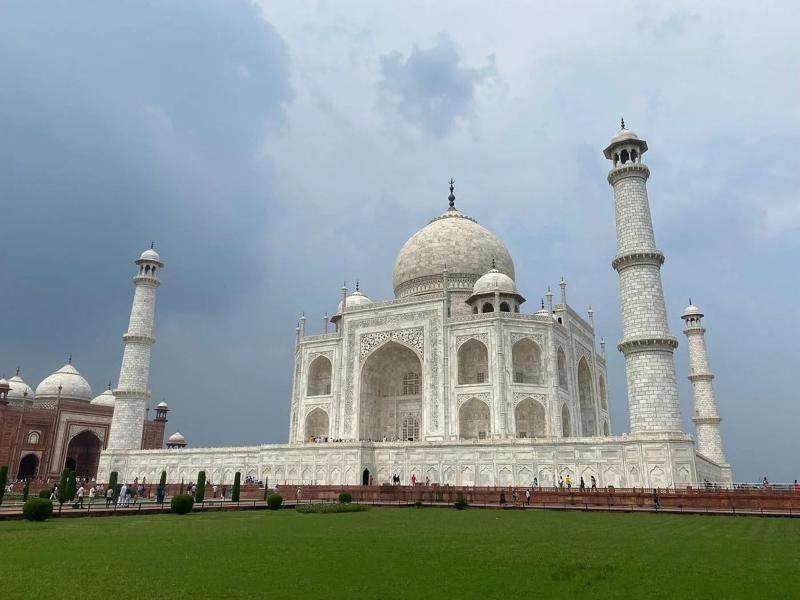
  • The Taj Mahal is the point of the day, so give it two to three hours and not the forty minutes most visits allow.
  • Shah Jahan finished it in 1653 for Mumtaz Mahal.
  • Walk the length of the water channel.
  • Go inside the mausoleum to see the pietra dura inlay and the marble screen around the cenotaphs.
  • Then walk to the river terrace at the back, where almost nobody stands, and the building looks most like the engineering feat it is.
  • In the afternoon, Agra Fort lies ten minutes away and it is far from a filler.
  • Shah Jahan was held here by his son Aurangzeb, in an octagonal tower with a view straight down the Yamuna to the Taj.
  • If there is light left, Itimad-ud-Daulah, the Baby Taj, is smaller, quieter and was finished about fifteen years before work on the Taj began.
  • Sunrise entry is the better visit if you prefer a quieter hour, and from December to January fog can hide it.
  • If you arrive in the morning instead, the last two hours before closing are the next best time, when the crowds thin and the light turns warm.
  • We choose with you.
Day3

Fatehpur Sikri, then the walled city of Jaipur

If you would like the Taj once more at opening, you can be at the gate early and on the road by 09:00.

  • Otherwise we leave Agra around 08:00.
  • Fatehpur Sikri is an hour west.
  • Emperor Akbar built it from nothing in the 1570s and left it after about fourteen years, so the entire complex survives without later rebuilding.
  • Ninety minutes is enough.
  • The great gateway, the Buland Darwaza, and the Diwan-i-Khas with its single carved central pillar are the parts people remember.
  • The site is lightly signed, so your guide is arranged in advance.
  • Another three hours brings you into Jaipur in the early afternoon.
  • Spend it in the old walled city, which is compact enough to cover on foot.
  • The City Palace is still partly the home of the former royal family.
  • Jantar Mantar is an eighteenth-century observatory of stone instruments built at architectural scale, including a sundial that reads time to the second.
  • The Hawa Mahal is a five-storey screen of small windows, built so that women of the court could watch the street unseen.
  • The front is best photographed in the morning from a rooftop cafe across the road.
  • Finish on the ridge at Nahargarh Fort for sunset over the grid of the city, then eat in the old town.
  • Tomorrow is the fort day, and it wants an early start.
Day4

Amber Fort, then Jaipur's crafts

Drive: five to six hours

Amber Fort is the reason the fourth day exists.

  • It lies about 11 km from the city, 30 to 40 minutes by car, and we arrive at opening, around 08:00.
  • The light on the hillside is good and the courtyards fill quickly by mid-morning.
  • The fort is a hill palace of successive courtyards, and the Sheesh Mahal, a hall inlaid with mirrors, is the piece most visitors come for.
  • We suggest walking up.
  • The climb takes about fifteen minutes, and the elephant ride has long drawn welfare concerns.
  • Below the fort, the Panna Meena ka Kund stepwell and the Jal Mahal, a palace that seems to float on its lake, are both a few minutes away.
  • You are back in the city by lunch.
  • The afternoon is where a second day in Jaipur pays off.
  • The city has been a working craft centre for about three centuries: hand block printing, blue pottery, gem cutting and textile work.
  • Spending two or three hours actually trying one of these is a better use of the time than adding another fort.
  • Or you can sit down to a home meal with a local family, or walk the old bazaars after dark.
  • If you fly out on day 5, Jaipur airport is about twenty minutes from the old city.
  • If you return to Delhi by road, allow five to six hours and leave early.
Practical

Things worth knowing

The Friday rule

The Taj Mahal is closed every Friday, all day. We fix your Agra date first and build the other days around it. The usual solution is to swap the order of the cities so Agra falls on another day, or to shift the trip by a day.

If your dates cannot move, a Friday in Agra still works. Spend it at Agra Fort, Itimad-ud-Daulah and Mehtab Bagh, the garden across the river with a direct view of the Taj. Then see the Taj at opening on Saturday morning before driving to Jaipur. Four days has just enough slack to absorb that, and it costs you a couple of hours of the Jaipur afternoon.

Moving between cities by car

One car and one driver stay with you throughout, and a licensed guide meets you in each city. Your driver knows the road, the rest stops and the rhythm of traffic on this corridor.

Agra to Jaipur is the longest day on the road, around four hours of driving plus the Fatehpur Sikri stop. We agree the route in advance and we do not take you to handicraft showrooms unless you ask. Those detours can swallow an afternoon.

Best season

October to March is the window. Skies are clear and you can be outdoors at midday. Rajasthan from April to June is dangerously hot, often above 45 degrees Celsius, and Amber Fort is an exposed hillside. July to September is monsoon.

Delhi's air quality is at its weakest from November to January. If anyone in your party has asthma, we keep Delhi to the single day this plan already gives it, and we tell you what to expect.

Choosing a hotel category

We arrange hotels by category and not by name. Most guests choose between a five-star hotel and a heritage palace or restored haveli. The five-star suits those who want dependable quiet and modern comfort. The heritage property suits those who want to sleep inside the history they are visiting.

With two nights in Jaipur, many guests put the heritage stay there, where the setting is part of the city's character, and choose a five-star in Delhi and Agra for easy arrivals. We are happy to mix categories.

Tickets, documents and what is included

Taj Mahal entry is cashless and QR based, and foreign visitors need their original passport at the gate. Your guide handles entry at each monument. Keep some small notes for tips and for the odd rickshaw.

The plan covers a private car with a driver, a licensed guide in each city and hotels arranged by category. Flights are not included. Rates are on request.

What four days leaves out

Four days does not include Ranthambore, which needs a full extra day for the drive and a dawn safari. It does not include Udaipur, which is six to seven hours by road from Jaipur or a short flight, with flights not included. If either matters to you, plan six days or more. Squeezing them in means arriving after dark and leaving before breakfast.

Questions

Good to know

Why add the extra day in Jaipur and not Delhi or Agra?
Jaipur loses the most from a half day. Amber Fort sits about 11 km out and needs a morning of its own, and the old city needs an afternoon. Agra's main sights fit comfortably in one day, and Delhi's highlights compress well.
Can I fly home from Jaipur, or must I go back to Delhi?
Jaipur has good domestic flights, and many guests fly to Delhi and connect, which is quicker than the five to six hour drive. Flights are not included in the plan. If your international flight leaves from Delhi the same day, we suggest flying and not driving.
Is Fatehpur Sikri worth the stop?
Yes. It sits directly on the road from Agra to Jaipur, so it costs little extra time. It is a complete Mughal capital that was left empty and never built over, which makes it easier to read than sites that stayed in use. Ninety minutes to two hours is enough.
Should we ride an elephant up to Amber Fort?
We advise against it. The rides on that ramp have long drawn welfare concerns, and the walk up takes about fifteen minutes. If the climb is a problem for someone in your group, tell us and we will arrange an alternative route.
Do we need a guide on this route?
You can manage parts of Agra and Jaipur alone. A guide changes the day in Old Delhi, where the lanes are hard to read, and at Fatehpur Sikri, where the site has little signage. In this plan a licensed guide meets you in every city.
Can I see the Taj Mahal twice in four days?
Yes, since you sleep in Agra. Some guests visit in the late afternoon on arrival and again at opening the next morning. The two visits feel like different buildings. It works especially well if a Friday has shifted your plan and left a spare Agra morning.
When is the best time to travel?
October to March. Avoid April to June, when Rajasthan is dangerously hot, and July to September, which is monsoon. From December to January fog can flatten a Taj sunrise, so we keep a second option ready.
Is this a good first trip to India?
It is the classic first trip, because distances are short and the roads on this corridor are the best in the country. The intensity comes from Delhi, not the route. That is why we put the busy Old Delhi morning on day one, when you are fresh, and keep a driver and guide beside you.
Journeys

Take it privately

Rates on request

Tell us when you are travelling.

A short message is enough. We will come back with a plan, personally.

Enquire
WhatsApp
Plan your journeyWhatsApp