← All guides

5 Days in India: Delhi, Agra and Jaipur by Private Car

Delhi, Agra, Jaipur · 5 days
Overview

Five days is the length at which the Golden Triangle stops feeling like a sprint. Delhi gets two full days, Agra gets one night, and Jaipur gets two. Nobody is asked to see a fort before breakfast and a palace after dark, every day, to make the numbers work.

The driving is kind. Delhi to Agra is about three to three and a half hours on the expressway. Agra to Jaipur is around four hours on the road, with Fatehpur Sikri sitting almost exactly halfway. You travel in your own car with your own driver, so there are no stations to reach and no luggage to carry through crowds. Your guide in each city joins you at the hotel and leaves you there at the end of the day.

One fixed point governs the whole plan: the Taj Mahal is closed every Friday. With five days you have room to work around it, but the choice should be made before anything else is arranged. We cover that below, and it is the first thing we check when we plan a trip with you.

Best for. First-time visitors who want the classic route done properly, with a slower hour left in every city, and who prefer a private car and a licensed guide to a fixed group departure.

Day by day

How the days go

Day1

Old Delhi and the Mughal city

Begin in Shahjahanabad, the walled city that Shah Jahan founded in the 1640s when he moved the Mughal court up from Agra.

  • The Jama Masjid sits at its centre.
  • From the southern minaret you can read the whole street plan of Chandni Chowk laid out below you, which makes the walk that follows far easier to understand.
  • Then go down into the lanes.
  • Khari Baoli is the spice market, Dariba Kalan was the silver street, and Paranthe Wali Gali is exactly what the name promises.
  • Arrive hungry.
  • Old Delhi street food is a cuisine of its own, and a guide earns their place here by knowing which counters cook in front of you and turn over quickly.
  • Aim to start around ten, once the shops have properly opened and before the afternoon crowd arrives.
  • In the afternoon, choose between the Red Fort and Humayun's Tomb.
  • If you only have energy for one, take the tomb.
  • It was finished in 1572 and uses the same four-part garden and raised platform that the Taj Mahal would use eighty years later.
  • Seen today, it turns the Taj from a single astonishing building into the end of a long line of ideas.
  • Check the weekday first: the Red Fort is closed on Mondays.
Day2

New Delhi, Qutub Minar and the south

The second day covers what the first one left out.

  • Start in the wide avenues of Lutyens' Delhi: India Gate, the long ceremonial axis, the gates of Rashtrapati Bhavan.
  • This capital was laid out from 1911 as a deliberate reply to the Mughal city a few kilometres north.
  • Standing between the two, you start to see how much argument is built into the stone.
  • From there the car heads south to Qutub Minar, a 73 metre tower of red sandstone begun in 1193.
  • In its courtyard stands an iron pillar that has gone some sixteen centuries without rusting.
  • Next door the Mehrauli Archaeological Park is quiet and full of tombs and old stepwells, and it is a good place to slow down.
  • Keep the late afternoon loose.
  • Khan Market and Dilli Haat suit anyone who wants to browse, and a long lunch suits everyone else.
  • On a Thursday, Nizamuddin Dargah holds qawwali singing after sunset.
  • It is a working shrine, not a performance, so sit towards the back, cover your head and let it happen around you.
  • Tomorrow starts early, so this is also a fair evening to rest.
Day3

Delhi to Agra, the Taj in the late light

Drive: three to three and a half hours

Leave Delhi after breakfast and take the Yamuna Expressway south.

  • The road is fast and well kept, and the journey runs three to three and a half hours with a short stop on the way.
  • Your driver will bring you to the hotel before check-in so that you can leave bags and freshen up.
  • A fast train does exist between the two cities, but this plan is built around the car, which keeps your luggage, your timing and your guide together.
  • Visit the Taj Mahal in the last two hours before closing.
  • The crowds thin out, the west face warms, and you are not rushing straight from a long drive to the most famous building in India.
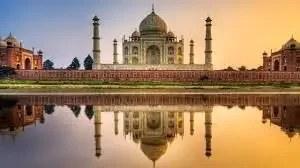
  • Shah Jahan built it between 1632 and 1653 for Mumtaz Mahal, in white marble from Makrana inlaid with semi-precious stones.
  • The river terrace at the back is the calmest corner of the complex.
  • If time remains, Agra Fort completes the story.
  • It is where Shah Jahan was held for his last years, in a tower with a clear view along the Yamuna to the Taj.
  • Across the river, Itimad-ud-Daulah is a smaller tomb finished in 1628, the first Mughal building faced entirely in marble.
  • Its inlay work is finer than the Taj's own.
  • Passports in original form are checked at the Taj gate, so keep yours with you rather than in the hotel safe.
Day4

Taj at sunrise, Fatehpur Sikri, into Jaipur

Go back at dawn.

  • This is the visit that justifies sleeping in Agra.
  • The gates open shortly before the sun, the crowd is a fraction of the daytime one, and the marble shifts from grey to pink to white over the first hour.
  • Allow ninety minutes, then return for breakfast and check out.
  • Be aware that in December and January fog can hide the sunrise entirely.
  • If that happens the building is still worth seeing, just in a softer, quieter light.
  • By about nine you are on the road.
  • An hour west, Fatehpur Sikri is the red sandstone capital Akbar built in the 1570s and left after fourteen years.
  • Because nothing was built over it, it reads as a complete city and not a heap of fragments.
  • The great gateway called the Buland Darwaza and the courtyards of the palace take around ninety minutes.
  • Your guide meets you at the entrance, so you can walk past the touts in the car park without a conversation.
  • Another three hours or so brings you into Jaipur by mid-afternoon.
  • Do not plan a monument today.
  • Walk the old city instead, look at the bazaars around Johari Bazaar, and eat early.
  • The rose-pink walls date from 1876, when the city was repainted to welcome a royal visitor and then simply kept that colour.
  • Tomorrow is the full day.
Day5

Amber Fort, the walled city and Nahargarh at sunset

Drive: five to six hours

Reach Amber Fort around opening time, about eight.

  • The palace climbs a ridge in stages, begun in 1592, and the sequence of courtyards is the point: through the Ganesh Pol gateway, into the Sheesh Mahal where mirrors cover the ceiling, then out to the garden below.
  • We suggest walking up the ramp rather than riding an elephant.
  • It takes about fifteen minutes and is kinder to the animals.
  • The stepwell Panna Meena ka Kund, just below the fort, takes ten minutes and is usually empty.
  • Return to the city by midday for the walled-city core.
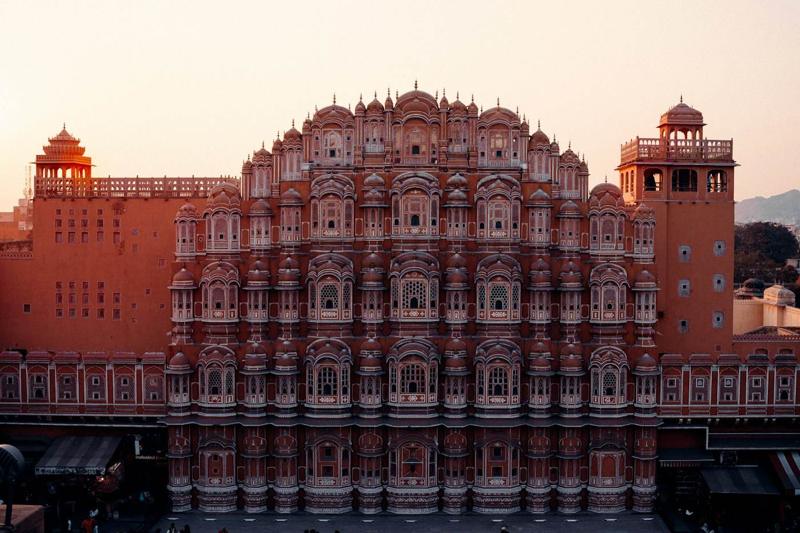
  • The City Palace, the Jantar Mantar with its stone astronomical instruments built in the 1730s, and the five-storey screen of the Hawa Mahal all stand within walking distance of one another.
  • After two days of driving, being on foot again is a relief.
  • Finish on the ridge at Nahargarh Fort for sunset.
  • Jaipur was laid out in 1727 on a nine-block plan, and from up there the grid is actually visible.
  • If your evening is free, a home-cooked dinner with a local family makes a better last night than a hotel restaurant.
  • Departure the next day can be a flight from Jaipur, or a drive back to Delhi of five to six hours.
Practical

Things worth knowing

The Friday rule and where your slack is

The Taj Mahal is closed every Friday, all day. Five days gives you room to absorb this. You can move the Agra night to another day, or keep it and spend the Friday on Agra Fort, Itimad-ud-Daulah and sunset at Mehtab Bagh, the garden directly across the river and aligned with the Taj. Then you take the Taj at sunrise on Saturday before driving to Jaipur. You lose about two hours of the Jaipur afternoon and nothing else.

Whichever you choose, work out the day of the week before hotels are fixed. Changing the plan in advance costs nothing. Changing it on the ground costs you a monument.

Moving between cities by car

Delhi to Agra is about three to three and a half hours by road. Agra to Jaipur is about four hours of driving, plus the time you spend at Fatehpur Sikri. Your driver stays with you for the whole trip, so there are no transfers to arrange and no waiting for anyone else's schedule.

For the end of the trip, Jaipur has an airport with regular domestic connections. If you must return to Delhi, the road takes five to six hours, and a short flight is the alternative. Flights are not included.

Best season

October to March is the season, and February and March are the most comfortable of those months. April to June is very hot in Rajasthan, often above 45 degrees, and Amber Fort's climb is fully exposed. July to September is monsoon, which does not ruin the route but slows the driving. Delhi's air is at its poorest from November to January, which matters for anyone with a breathing condition.

In December and January, early fog can flatten a Taj sunrise. We build a margin into the morning so that you can wait an hour for it to lift.

Choosing your hotel category

We arrange hotels by category rather than by name. Most guests choose between a modern five-star, which suits those who want a quiet, reliable base after a full day, and a heritage palace or restored haveli, which suits those who want the stay itself to be part of the journey. Jaipur and Agra both have good examples of each.

A useful rule: if your days are long, pick the more restful option in Agra, where you have an early start. Put the character stay in Jaipur, where you have an unhurried evening.

Documents and daily comfort

Carry your original passport on the Taj day. Dress for shoulders and knees at working shrines and mosques, and bring socks for marble floors that get hot in the afternoon. Your driver keeps water in the car throughout. Rates for the full itinerary are given on request, tailored to your dates and hotel category.

What five days gives you over four

The extra day goes entirely to Delhi, and it is the difference between seeing Old Delhi or New Delhi and seeing both. It also gives you what every crowded itinerary leaves out: a spare afternoon. That is the part that makes a trip enjoyable when a road is slow or the heat catches up with you.

Questions

Good to know

Is two days in Delhi too many?
No. Delhi holds a Mughal walled city, a British-era capital and a set of twelfth-century ruins in the south, and they sit far apart. One day forces a choice between them. Two days lets you see the first two properly and still look at the third.
What if my Agra day is a Friday?
The Taj Mahal is closed on Fridays. You can move the Agra night to another day. Or you keep it and spend Friday on Agra Fort, Itimad-ud-Daulah and sunset at Mehtab Bagh, then see the Taj at sunrise the next morning before the drive to Jaipur.
Can I add Ranthambore for a tiger safari?
Not comfortably within five days. Ranthambore is roughly four hours from Jaipur, and a proper visit means an overnight stay and a dawn safari. That turns the trip into six or seven days. If tigers matter more to you than Jaipur's second day, we can plan that version instead.
Should I see the Taj Mahal at sunrise or sunset?
If you only go once, go at sunrise. The crowd is smaller and the colour change over the first hour is what most people remember. This plan lets you see it twice: late on Day 3, and again at dawn on Day 4. Fog in December and January can hide a sunrise, so the afternoon visit is a useful safeguard.
How far ahead should I plan?
Hotels in the October to March season are best settled four to six weeks ahead. Once your dates are fixed we confirm your car, driver and guides, and we check the Friday question first. A week or two is usually enough for the guiding side.
Is it safe to eat street food in Old Delhi?
The reliable rule is turnover. Eat where there is a queue and the food is cooked in front of you, and avoid anything that has been sitting out. Going with someone who knows the specific stalls takes the guesswork away, which is most of what a food walk is for.
Do I have to stay in the car all day?
No. The car carries you between places, and your driver waits while you walk. Most of each day is on foot with your guide, in short stretches between a comfortable seat and the next site. The long drives are only the two travel legs, and each has a stop in the middle.
Where should this trip end, Jaipur or Delhi?
Jaipur, if your onward flight allows it, because it saves a five to six hour drive. If you must finish in Delhi, the road is the straightforward option and a short flight is the faster one. Flights are not included, and we can advise on timings when you tell us your departure.
Journeys

Take it privately

Rates on request

Tell us when you are travelling.

A short message is enough. We will come back with a plan, personally.

Enquire
WhatsApp
Plan your journeyWhatsApp