← All guides

8 Days in India: The Golden Triangle, Jodhpur and Udaipur by Private Car

Delhi, Agra, Jaipur, Jodhpur, Udaipur · 8 days
Overview

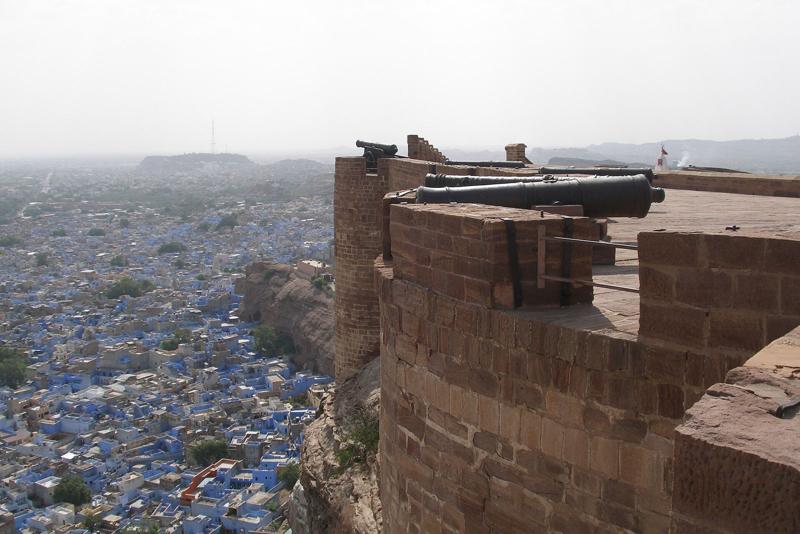
The eighth day is what brings Jodhpur into the route. With it, the trip stops being the Golden Triangle with an add-on and becomes a Rajasthan journey. Mehrangarh Fort rises about 120 metres above the blue-washed houses of the old city. It is still held by the family that built it, and it was never taken by assault. Of everything on this itinerary, the Taj Mahal included, it is the building with the greatest physical presence.

The price of adding it is one night and one long road day. You get a single night in Jodhpur, which is enough for the fort and the old lanes below it, and not much else. If you want the Bishnoi villages, a jeep ride into the scrub or a slow morning in the market, that belongs to a nine day version. What eight days does well is give you five very different places without a wasted day.

The plan is built around a private car and driver, a licensed guide in each city, and hotels arranged by category. One fact decides the order of the days: the Taj Mahal is closed every Friday. Here you see it on Day 4, so count four days forward from your arrival before you fix anything else.

Best for. Travellers with a little over a week who want the Golden Triangle plus a real taste of western Rajasthan, and who would rather see Jodhpur briefly than not at all. Rates are on request.

Day by day

How the days go

Day1

Arrive in Delhi and begin with Humayun's Tomb

Flights into Delhi tend to land in the early morning or the middle of the night, so we plan Day 1 as a half day.

  • If you arrive before dawn, tell us and we will have your room ready, so that you can rest before the afternoon.
  • In the afternoon your guide takes you through New Delhi to Humayun's Tomb.
  • It was completed in 1572, and it is the first great garden tomb of the Mughal empire.
  • It is also the direct ancestor of the Taj Mahal.
  • Seeing it first means that on Day 4 the Taj arrives as the end of a line and not as a surprise.
  • If you have the energy, add the Qutub Minar and a drive past India Gate.
  • Then stop.
  • Distances in Delhi are long, traffic is real, and tomorrow is a full day in the old city.
Day2

Old Delhi, Jama Masjid and Chandni Chowk

Old Delhi in the morning is not the same place as Old Delhi at two in the afternoon.

  • Begin at Jama Masjid, the largest mosque in India.
  • If the southern minaret is open, the climb gives you a view over the rooftops.
  • Then you go down into Chandni Chowk with your guide.
  • A cycle rickshaw is the practical way through the lanes.
  • The spice market at Khari Baoli and the silver bazaar are too narrow for a car and too far apart to cover comfortably on foot.
  • Lunch is built into the walk.
  • Parathas, kebabs, a kulfi if you have room, and a lassi, which is best ordered in a small glass.
  • In the afternoon, visit the Red Fort, or choose a quiet hour at Raj Ghat if the morning has been enough.
  • Do not add a fourth stop.
  • Tomorrow you leave early for Agra.
Day3

Drive to Agra, then Agra Fort, the Baby Taj and Mehtab Bagh

Drive: about three to three and a half hours

The drive from Delhi to Agra on the Yamuna Expressway takes about three to three and a half hours.

  • Your driver leaves after breakfast and you can stop wherever you like.
  • A fast train covers the same distance in around 100 minutes, but the car carries your luggage and your timing is your own, so the plan uses the car.
  • Today is deliberately not a Taj Mahal day.
  • The afternoon goes to Agra Fort, a walled city in red sandstone that was the seat of the empire before Delhi was.
  • Shah Jahan added marble palaces inside it.
  • From the octagonal tower where he spent his final years, held by his son Aurangzeb, he could see the Taj downriver.
  • The view means more before you have stood in front of the tomb itself.
  • Next comes Itimad-ud-Daulah, the Baby Taj.
  • It is small, often quiet, and it is among the first Mughal tombs faced in white marble with inlaid stone.
  • The day ends at Mehtab Bagh across the Yamuna, where the Taj is reflected in the river and there are few people beside you.
Day4

The Taj Mahal at sunrise, Fatehpur Sikri, and on to Jaipur

Drive: about four hours

Be at the gate before it opens.

  • Shah Jahan started the Taj Mahal in 1632 for Mumtaz Mahal, and the work took about two decades.
  • In early light the Makrana marble shifts from grey through pink to white, and you notice how much of the surface is inlaid stone rather than carving.
  • Get close to the plinth.
  • The flowers set into the marble are what the building is truly about.
  • Two hours inside is right.
  • Your guide manages the East Gate and the security line.
  • Carry a phone, a wallet and your original passport, and leave bags in the car.
  • Then comes breakfast, check-out and the road to Jaipur, about four hours.
  • An hour out of Agra is Fatehpur Sikri.
  • Akbar built a whole capital here in the 1570s and left it after some fourteen years, most likely over the water supply.
  • Very little has fallen down and very few people are inside, which makes it the best roadside stop on the itinerary.
  • You reach Jaipur by late afternoon.
  • It is a long day, and the only honest advice is to keep the evening free.
Day5

Amber Fort, the walled city and Nahargarh

Begin at Amber Fort at eight.

  • It lies about eleven kilometres out of town, up a hillside above Maota Lake.
  • The mirrored Sheesh Mahal is small and draws a queue by mid-morning.
  • The ramparts and stepped courtyards do not, and they are the better part of the visit.
  • Then return inside the walls.
  • Jaipur was laid out on a grid in 1727, which makes it a city you can read from a map.
  • The City Palace museum, the stone instruments of Jantar Mantar and the honeycomb front of the Hawa Mahal sit within a few hundred metres of one another.
  • Jantar Mantar in particular is puzzling alone and absorbing with a guide.
  • If you would like something to do with your hands, Jaipur is the place for it.
  • Block printing and blue pottery are real local crafts, and a short workshop visit can be arranged.
  • Finish at Nahargarh on the ridge for the last half hour of light over the whole city.
Day6

West to Jodhpur, and Mehrangarh in the late light

Drive: six hours

This is the longest road day of the plan: five and a half to six hours from Jaipur to Jodhpur, across flat, dry country that grows emptier as you go.

  • Leave by seven if you can, because an early start gives you more daylight at the fort.
  • A flight on this route usually connects through Delhi and takes longer door to door, so we use the car.
  • Go straight to Mehrangarh on arrival.
  • The fort stands on a cliff of about 120 metres above the old city.
  • The palace rooms inside are intact rather than rebuilt, and the audio guide is unusually good.
  • From the ramparts, the blue houses of the old town spread directly below you.
  • With one night, you have to choose, and the best choice is the fort in the late afternoon followed by a walk down through the blue lanes to the clock tower and the Sardar Market at dusk.
  • If time is short, leave out Jaswant Thada.
  • Do not leave out the walk.
Day7

Through the Aravalli hills to Udaipur

Drive: about five hours

Jodhpur to Udaipur is about five hours, and it is the most scenic road of the trip, dropping out of the desert and into the Aravalli hills.

  • Leave at eight and you reach Udaipur for a late lunch with the afternoon intact.
  • Ranakpur lies roughly on this road and adds about two hours.
  • On an eight day trip most travellers should leave it for another visit.
  • Udaipur is the change of tone the route has been building toward.
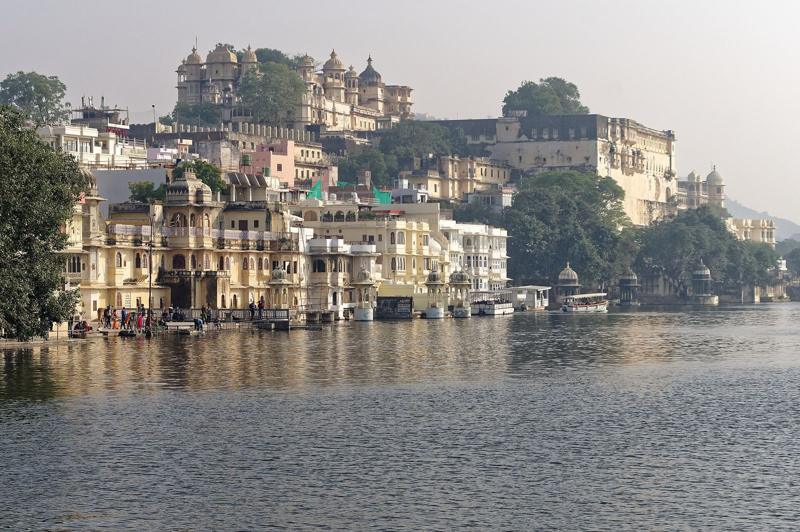
  • The city is built around Lake Pichola, with the City Palace running for a quarter of a mile along the eastern shore.
  • It is quieter, greener and smaller in scale than anything since Delhi.
  • Visit the palace in the afternoon, then walk through the old town to Jagdish Temple.
  • End the day on the water.
  • The sunset boat takes about an hour, passes the Lake Palace and stops at Jag Mandir island.
  • For many travellers it is the part of the trip they remember most.
Day8

A slow morning in Udaipur, then departure

Udaipur has direct flights to Delhi and Mumbai, and most eight day trips end here in the afternoon.

  • Flights are not included.
  • The morning is left open on purpose, because after seven days of forts an unplanned morning is the right use of it.
  • Walk the ghats before the shops open.
  • Have a long breakfast with a view of the water.
  • If you want one more place, go up to Sajjangarh, the monsoon palace on the ridge, for the view over the lakes and the hills behind.
  • Or spend an hour at Bagore Ki Haveli, a restored merchant's house on the waterfront, which has a folk performance in the evening if your flight is late.
  • If you are flying out on the morning of Day 9, the day trip to Kumbhalgarh and Ranakpur is the best full day available from Udaipur.
  • Kumbhalgarh is a fort with the second longest continuous wall in the world, and Ranakpur is a Jain temple with 1,444 carved marble pillars, none alike.
  • It takes about ten hours, so it only fits if the whole day is free.
Practical

Things worth knowing

The Friday rule, and how to count your days

The Taj Mahal is closed every Friday, all day, for prayers at the mosque inside the complex. There is no shortened opening. Many itineraries ignore this, and travellers arrive at the gate on a Friday with a flight out the next day.

Here the Taj falls at sunrise on Day 4. Count four days forward from your arrival date before booking flights. If Day 4 is a Friday, the easy fix is to move your arrival by one day. If your flights are fixed, we can flip the Agra half: the Taj on Thursday afternoon after arriving on Day 3, then Friday morning for Agra Fort and Itimad-ud-Daulah before driving on. Afternoon light is harsher and busier, but it is better than missing the Taj.

Moving between cities by car

Delhi to Agra is about three to three and a half hours. Agra to Jaipur is about four. Jaipur to Jodhpur is five and a half to six, and Jodhpur to Udaipur about five. Fatehpur Sikri, the desert stretch and the hills near Udaipur are all easier by car than by any other means.

Your driver and car stay with you for the whole route, so there is no negotiating leg by leg, and you can stop for tea or a photograph. We would not suggest self-driving for a first visit. The traffic has its own logic, and a local driver reads it far better than a visitor can.

When to go

October to March is the season. From April the Rajasthan desert passes 45 degrees Celsius, and May and June are hard on anyone walking around forts at midday. July to September is the monsoon, greener but unpredictable, and a road day can run much longer than planned.

Within the good season, Delhi's air is at its worst from November to January. If anyone in your group has asthma or you are travelling with young children, February and March offer the same comfortable temperatures with cleaner air.

Choosing your hotel category

We arrange hotels by category, not by name. You can choose five-star hotels, which give a steady standard of comfort in every city, or heritage palace stays, which are converted historic buildings with more character and often fewer rooms.

A simple way to decide: if you want the same standard each night, go five-star. If the buildings are part of why you came, choose heritage in Jaipur, Jodhpur and Udaipur, and keep five-star in Delhi and Agra. Tell us which you prefer and we will build the days around it. Rates are on request.

Why Jodhpur gets one night

Five cities in eight days means one of them gets short measure, and Jodhpur is the right one. Its two headline experiences, Mehrangarh and the blue lanes, sit within a kilometre of each other. You can do both properly in an afternoon and an evening.

What you lose is everything outside the walls: the Bishnoi village circuit, a jeep ride into the scrub, a morning in the Sardar Market when it is fully working. If those matter to you, add a day and use the nine day version. Do not try to fit them into the morning you are meant to be driving to Udaipur.

Pacing, honestly

Two days are hard: Day 4, which begins before sunrise at the Taj and ends with a four hour drive, and Day 6, which is six hours in the car followed by a fort. Days 1, 2, 5, 7 and 8 are comfortable, and the last two are deliberately slow.
Questions

Good to know

Is 8 days enough for the Golden Triangle and Rajasthan?
It is enough for the Golden Triangle plus two Rajasthan cities at a workable pace. Delhi, Agra and Jaipur take five days, leaving one night in Jodhpur and two in Udaipur. It does not stretch to Jaisalmer or the desert.
Which day of the week should I avoid for Agra?
Friday. The Taj Mahal is closed every Friday for prayers, with no exceptions. This plan sees it at sunrise on Day 4, so count four days from your arrival and move by a day if it lands on a Friday.
Is one night in Jodhpur enough?
It is enough for Mehrangarh Fort and a walk through the blue lanes, which are what most people come for, provided you arrive while the fort is open. It is not enough for the Bishnoi villages or a desert ride. For those, choose the nine day version.
Do we drive or fly from Jaipur to Jodhpur?
We drive. It takes five and a half to six hours, and flights usually connect through Delhi, which is slower door to door. Your driver can stop along the way. A train also runs on the route in about five hours, but the plan uses the car.
Is the drive from Jodhpur to Udaipur difficult?
No, and it is the best road day of the trip. It takes about five hours and drops from the desert into the Aravalli hills. Ranakpur can be added for roughly two extra hours, though on eight days it usually means reaching Udaipur after dark.
When should I travel?
October to March. April to June passes 45 degrees Celsius in Jodhpur and across Rajasthan, and July to September is the monsoon. Delhi's air is worst from November to January, so February and March suit anyone with respiratory trouble.
How is the trip arranged, and are flights included?
You travel with a private car and driver, a licensed guide in each city and hotels arranged by category. Flights, including any onward flight from Udaipur, are not included. Rates are on request, and we build the plan around your dates.
Can I add Jaisalmer to these eight days?
Not without spoiling the trip. Jodhpur to Jaisalmer is about five hours each way, and Jaisalmer back to Udaipur is nine to ten hours, so two of your days become only driving. Jaisalmer belongs in a ten day plan.
Journeys

Take it privately

Rates on request

Tell us when you are travelling.

A short message is enough. We will come back with a plan, personally.

Enquire
WhatsApp
Plan your journeyWhatsApp