← All guides

7 Days in India: Delhi, Agra, Jaipur and Udaipur by Private Car

Delhi, Agra, Jaipur, Udaipur · 7 days
Overview

Seven days is the first length at which a trip to India stops being a list. In three or four days the Golden Triangle is mostly a series of monuments passed at speed. With a full week you can give Delhi two proper days, see the Taj Mahal at first light instead of mid-morning, and end somewhere that asks nothing of you.

That last part is the reason Udaipur is on this route. Delhi, Agra and Jaipur are dense, loud and rewarding, and by the fifth day most travellers are tired. Udaipur is a lake city, built around water and shade. After four days of Mughal and Rajput architecture, it is where the week slows down. You can reach it by a short domestic flight (flights are not included) or by a long day in the car.

This plan is built around a private car and driver, with a licensed guide in each city and hotels arranged by category. Your driver stays with you from the first morning to the last, which means no queues for taxis, no bargaining and no waiting for a train timetable to suit your day. One date matters more than any other: the Taj Mahal is closed every Friday. In this plan you see it on Day 4, so count four days forward from your arrival before you fix anything else.

Best for. First-time visitors with a full week who want the Golden Triangle at a sane pace, followed by two quiet days beside a lake. Rates are on request.

Day by day

How the days go

Day1

Arrive in Delhi, and keep it light

Most international flights reach Delhi in the small hours or early morning.

  • Treat Day 1 as a half day.
  • If you land before dawn, we can arrange for your room to be ready on arrival, so that you can sleep before anything else happens.
  • Two hours of rest do more for the week than one extra monument.
  • In the afternoon, your driver and guide take you through New Delhi, the wide, green part of the city.
  • Start at Humayun's Tomb, finished in 1572.
  • It is the first great garden tomb of the Mughal line, and it is the ancestor of the Taj Mahal you will see on Day 4.
  • Seeing it first means the Taj arrives as the end of a story.
  • If you have energy, add the Qutub Minar complex and a slow drive past India Gate.
  • That is enough.
  • The distances in Delhi are long and the traffic is real, and tomorrow is a full day.
Day2

Old Delhi on foot, then the Red Fort

Old Delhi belongs to the morning.

  • By early afternoon the heat is up and the lanes are jammed, but at eight it is busy in a way you can enjoy.
  • Begin at Jama Masjid, the largest mosque in India.
  • From there you go down into Chandni Chowk, with your guide leading you through the bazaar.
  • A cycle rickshaw is the right way to see the narrow lanes.
  • They are too tight for a car and too long to walk end to end.
  • You pass the spice market at Khari Baoli and the silver lanes, and you see the city at handlebar height.
  • Lunch is part of the walk, not a separate event.
  • Old Delhi has some of the best street food in the north, and on your second day it helps to have a guide choose the stalls with fast turnover.
  • Parathas in Paranthe Wali Gali, kebabs near the mosque, something sweet at the end.
  • In the afternoon, visit the Red Fort, or go quietly to Raj Ghat if the morning has used you up.
  • Stop there.
  • Two focused half days in Delhi are better than one exhausted push.
Day3

Drive to Agra, then Agra Fort and Mehtab Bagh

Drive: about three to three and a half hours

The drive from Delhi to Agra takes about three to three and a half hours on the Yamuna Expressway, a modern road that is smooth and quick.

  • Your driver leaves after breakfast, and you can stop where you like. (A fast train exists between the two cities, but the car suits this plan better: it takes your luggage, keeps your timing flexible and spares you a station transfer.)
  • You do not see the Taj Mahal today, and that is deliberate.
  • After checking in, go to Agra Fort.
  • It is red sandstone from the outside and white marble within, and it was the centre of the empire before Delhi took that role.
  • The marble palaces that Shah Jahan added are inside.
  • From the Musamman Burj, the tower where he spent his last years confined by his son, you look along the river to the tomb he built for his wife.
  • It is a stronger moment when you have not yet seen the Taj up close.
  • If time allows, stop at Itimad-ud-Daulah, the small tomb known as the Baby Taj.
  • It is quiet, finely inlaid and often nearly empty.
  • Then cross the Yamuna to Mehtab Bagh for the evening light.
  • From the garden you see the Taj from behind, across the water, with few other people around.
Day4

The Taj Mahal at sunrise, Fatehpur Sikri, and on to Jaipur

Drive: about four hours

This is the day the trip is built around.

  • Be at the gate before it opens.
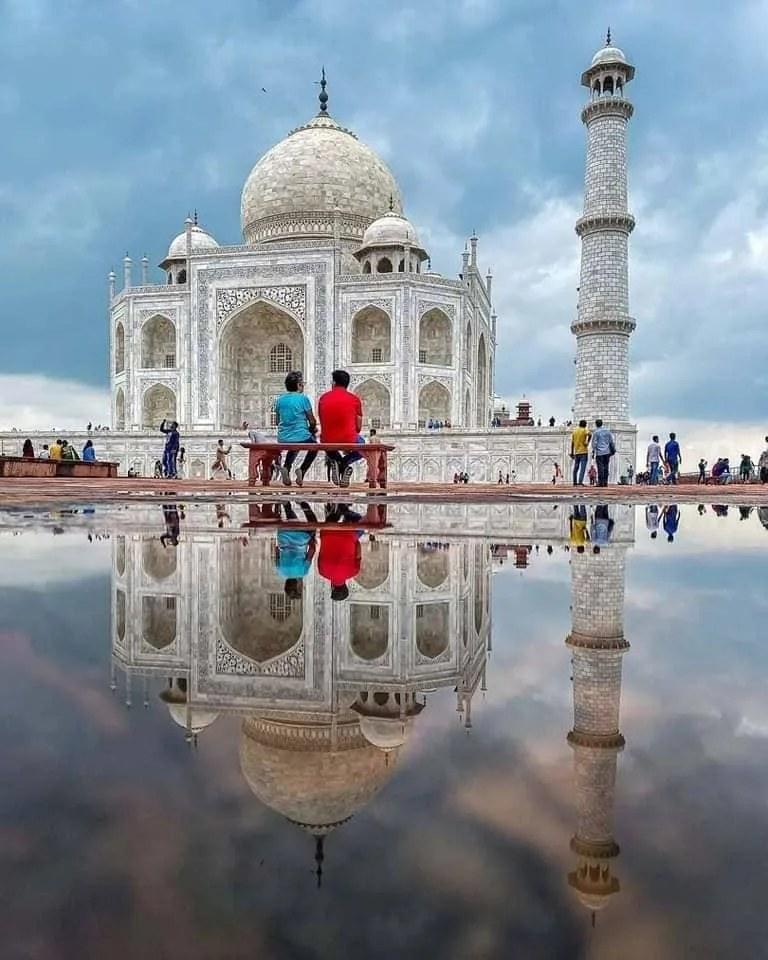
  • The Taj Mahal is Makrana marble, which is slightly translucent, and in the first forty minutes of light it moves from grey to pink to white.
  • At that hour the crowd is a fraction of what it will be by nine.
  • Shah Jahan began the tomb in 1632 for Mumtaz Mahal and the work ran for about two decades.
  • Go close to the plinth.
  • The inlaid flowers, cut from coloured stone and set into the marble, are what the building is really about.
  • Your guide handles the East Gate entry, the security queue and the timing.
  • Carry only a phone, a wallet and your original passport, which is checked at the gate.
  • Large bags, tripods, drones and food stay in the car.
  • Allow two hours inside, then go back to the hotel for breakfast and check out.
  • The road to Jaipur takes about four hours.
  • About an hour out of Agra is Fatehpur Sikri, the capital Akbar built in the 1570s and left after some fourteen years, most likely because the water failed.
  • It is largely intact and largely empty, and it is the best stop on any road day in this plan.
  • You reach Jaipur in the late afternoon.
  • It is a long day, started at five and spent mostly on the move.
  • Plan nothing for the evening except dinner.
Day5

Amber Fort, the Pink City and Nahargarh

Start at Amber Fort at eight.

  • It stands on a hillside above Maota Lake, a Rajput palace complex that the Mughals influenced but never flattened.
  • By eleven there is a queue for the mirrored hall, the Sheesh Mahal.
  • Go early and you have the ramparts and the courtyards close to empty, which is the better part of the visit anyway.
  • Then come back into the walled city for the middle of the day.
  • The City Palace is still partly the home of the royal family, and its museum rooms are worth an hour.
  • Next door, Jantar Mantar is an 18th century observatory of stone instruments that still tell the time accurately.
  • It makes little sense without a guide and is quietly fascinating with one.
  • The Hawa Mahal takes twenty minutes and a photograph, which is what it was designed for.
  • The best view of it is from a rooftop cafe across the street.
  • Keep the last hour of light for Nahargarh Fort on the ridge.
  • From there the whole city is laid out below you, and Jaipur finally makes sense as one plan rather than a set of separate sights.
Day6

To Udaipur, and a slow evening on the lake

Drive: six to seven hours

There are two ways to reach Udaipur.

  • A morning flight takes a little over an hour, and our team can help you with that option, though flights are not included.
  • By road it is six to seven hours, and the first four are plain highway.
  • If you prefer the car, leave at seven and expect to arrive in the mid-afternoon.
  • On a seven day trip, the flight gives you most of a day back.
  • Udaipur changes the tone completely.
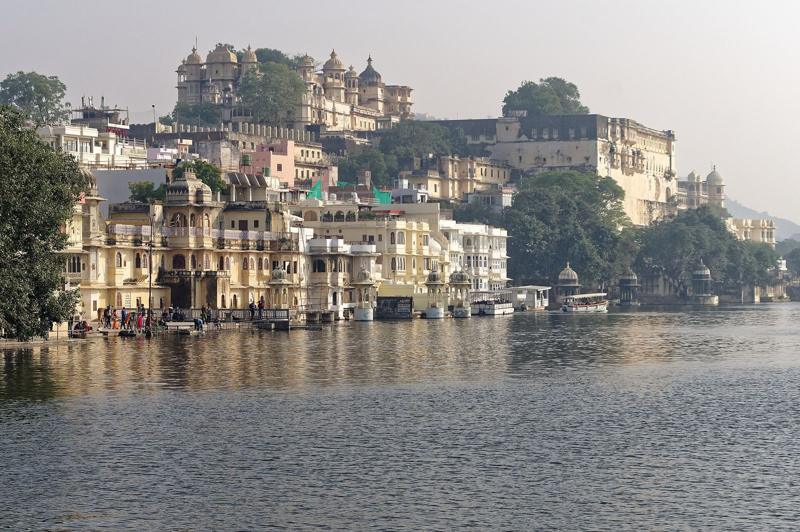
  • The city is built around Lake Pichola, with the City Palace running along the eastern shore.
  • It is the one place on this route where doing less is the point.
  • Begin with the palace, a group of connected buildings added to over four centuries.
  • Then walk down through the old town to Jagdish Temple and the ghats.
  • End on the water.
  • The sunset boat on Lake Pichola takes about an hour, passes the Lake Palace and stops at Jag Mandir.
  • For many travellers it is the best single hour of the week.
Day7

A slow Udaipur morning, then home

Udaipur has direct flights to Delhi and Mumbai, and most travellers on a seven day plan fly out in the afternoon or evening.

  • That leaves a morning, and the right use of it is not another fort.
  • Walk the old town before the shops open.
  • Have a long breakfast on a rooftop with the lake in front of you.
  • If you want one more place with substance, go up to Sajjangarh, the monsoon palace on the hill, for the view back over the city and the Aravalli range.
  • Bagore Ki Haveli, a restored merchant's house on the ghats, has a small folk dance performance in the early evening if your flight is late.
  • If you are flying out on the morning of Day 8 instead, the day trip to Kumbhalgarh and Ranakpur is the best full day from Udaipur.
  • Kumbhalgarh is a 15th century fort with the second longest continuous wall in the world.
  • Ranakpur is a Jain temple of white marble with 1,444 pillars, no two alike.
  • It takes about ten hours, so it only fits if the whole day is free.
Practical

Things worth knowing

The Friday rule, and how to count your days

The Taj Mahal is closed every Friday, all day, for prayers at the mosque inside the complex. There is no shortened opening and no exception. Many itineraries online ignore this, and travellers end up at the gate on a Friday with a flight out the next day.

In this plan the Taj falls at sunrise on Day 4. Count four days forward from your arrival date before you book flights. If Day 4 is a Friday, the simplest fix is to move your arrival by a day. If your flights are fixed, we can reverse the Agra half: see the Taj on Thursday afternoon after arriving on Day 3, and use Friday morning for Agra Fort and Itimad-ud-Daulah before driving on. Afternoon light is harsher and the crowds are heavier, but it is better than missing the Taj.

Moving between cities by car

Delhi to Agra is about three to three and a half hours. Agra to Jaipur is about four, with Fatehpur Sikri on the way. Jaipur to Udaipur is six to seven hours by road, or just over an hour by air.

Your driver and car stay with you through the Golden Triangle leg. Because the car is yours, you can stop for a tea, a photograph or a break without negotiating. Self-driving is not something we would suggest for a first visit to India. The traffic has its own logic, and a local driver reads it far better than any visitor can.

When to go

October to March is the season. From April the Rajasthan heat passes 45 degrees Celsius, and May and June are hard on anyone walking around forts at midday. July to September is the monsoon: greener and quieter, but road days can run much longer than planned.

Within the good season, Delhi's air is at its worst from November to January. If anyone in your group has asthma or is travelling with small children, February and March give the same pleasant temperatures with cleaner air.

Choosing your hotel category

We arrange hotels by category rather than by name. The two choices are five-star hotels, which offer consistent comfort and service in every city, and heritage palace stays, which are converted historic buildings with more character and often fewer rooms. Both work well on this route.

A useful way to choose: if you want the same reliable standard each night, go five-star. If the buildings are part of why you came, choose heritage in Jaipur and Udaipur, and keep a five-star in Delhi and Agra. Tell us which you prefer and we will build the week on it. Rates are on request.

What seven days cannot include

This route does not reach Varanasi, Amritsar, Jodhpur or Jaisalmer, and it should not try. Varanasi needs a flight each way and two nights of its own. Jodhpur turns a paced week into a transfer schedule. Amritsar lies far in the wrong direction. If you want western Rajasthan, you need nine or ten days.

Pacing, honestly

Day 4 is the hard one: a five o'clock start at the Taj, two hours at Fatehpur Sikri and four hours in a car. The other days are comfortable. If you can stretch the plan, the best upgrade is a second night in Agra, which splits Day 4 across two mornings.
Questions

Good to know

Is 7 days enough for India?
It is enough for one region done well, not for two. Seven days covers Delhi, Agra, Jaipur and Udaipur at an easy pace, with time to sit still at the end. It does not stretch to Varanasi, Kerala or the desert.
Which day should the Taj Mahal be on?
Any day except Friday, when it is closed all day. In this plan the Taj is at sunrise on Day 4, so count four days from your arrival. If that falls on a Friday, we move your arrival by a day or switch to a Thursday afternoon visit.
Is the Taj Mahal worth getting up early for?
Yes. At sunrise the crowd is small, the air is cooler and the Makrana marble changes colour as the light rises. If you do one early start in India, make it this one. In December and January fog can hide the building for a while, and we plan around that.
Do we travel between cities by car or train?
By private car with a driver. It suits the route because Fatehpur Sikri lies on the road to Jaipur and your timing stays flexible. A fast train between Delhi and Agra exists, but this plan is built around the car.
Do I need to fly from Jaipur to Udaipur?
You do not have to, but on seven days it is worth considering. The flight is a little over an hour, against six to seven hours on the road, so it gives you most of an extra day in Udaipur. Flights are not included, and the drive is a good alternative if you leave early.
When is the best time of year for this route?
October to March. From April to June the Rajasthan heat passes 45 degrees Celsius, and July to September is the monsoon. Delhi's air is worst from November to January, so February and March suit anyone with asthma.
Can this itinerary be done in reverse, starting in Udaipur?
Yes, and it works well if you are arriving from Mumbai. Delhi then becomes the last stop, close to the main international airport. The Friday arithmetic changes: in reverse, Agra falls on Day 6, so count six days forward instead of four.
Is it safe to eat street food in Delhi and Agra?
With one rule, yes: eat where there is a queue and fast turnover. That is why we suggest a guided food walk early in the trip. Drink bottled or filtered water throughout, including for brushing teeth.
Journeys

Take it privately

Rates on request

Tell us when you are travelling.

A short message is enough. We will come back with a plan, personally.

Enquire
WhatsApp
Plan your journeyWhatsApp