← All guides

10 Days in India: Golden Triangle, Jodhpur, Jaisalmer and Udaipur by Private Car

Delhi, Agra, Jaipur, Jodhpur, Jaisalmer, Udaipur · 10 days
Overview

Ten days is the shortest trip that can honestly include Jaisalmer. It lies five hours west of Jodhpur, far enough into the Thar that farmland with scrub gives way to true desert. Its fort is the last in India with a living town inside the walls, and it feels unlike anything else on this route.

The trip pays for that in a single day. The road from Jaisalmer back to Udaipur takes nine to ten hours and there is no useful flight, so Day 9 is a transfer day and little else. Many ten-day plans tuck this away in a line that says only 'drive to Udaipur'. We would rather say it plainly. If the arithmetic bothers you, there is a reordered route below that saves about five hours in the car.

The rest is the Golden Triangle at a fair pace: two days in Delhi, a night in Agra with the Taj Mahal at sunrise, two days in Jaipur, and then west. One rule overrides the others. The Taj Mahal is closed every Friday. Here you see it at sunrise on Day 4, so count four days forward from the day you land before you settle your flights. You travel with your own car and driver, with a licensed guide in each city.

Best for. Travellers with a full ten days who want the desert as well as the Golden Triangle, and who accept one whole day in the car to bring Jaisalmer into the trip.

Day by day

How the days go

Day1

Delhi, and where the Taj Mahal begins

Nearly every long-haul flight reaches Delhi between midnight and eight in the morning.

  • Reserve your first hotel night for the evening before you land, so the room is yours when you arrive.
  • Your driver meets you at the airport.
  • That small arrangement does more for the next ten days than any upgrade.
  • In the afternoon, once you are functional, go to Humayun's Tomb in New Delhi.
  • Finished in 1572 for the second Mughal emperor, and largely designed by his widow, it is the first great Mughal garden tomb: a dome of marble and sandstone in a walled garden of four parts with water channels running toward it.
  • Eighty years later Shah Jahan builds the same idea in white marble beside a river.
  • Seeing the original on Day 1 gives Day 4 its meaning.
Day2

Old Delhi, the mosque, the lanes and the food

Old Delhi has a working day that ends around two in the afternoon, so be at Jama Masjid by nine.

  • Shah Jahan finished it in 1656 and its courtyard holds twenty-five thousand people.
  • It is the one wide, still place in this half of the city, and the southern minaret gives the best view over the rooftops of the old town.
  • Then walk into Chandni Chowk, with a cycle rickshaw for the longer stretches.
  • You pass Khari Baoli, the great spice market, where the air is sharp enough to make you cough.
  • You pass Dariba Kalan, the silver lane, and Kinari Bazaar, where wedding trimmings are sold.
  • None of this is preserved for visitors.
  • It is a wholesale district that has traded since the seventeenth century and behaves like one.
Day3

Agra, the fort before the tomb

Drive: three to three and a half hours

The Yamuna Expressway takes three to three and a half hours from Delhi to Agra, and the road is a good one.

  • A fast train also makes the run in about 100 minutes, but our plan keeps you in your own car, with your luggage and your guide beside you.
  • You do not see the Taj Mahal today, and that is deliberate.
  • Agra Fort takes the afternoon.
  • It is a red sandstone walled city that was the Mughal seat before Delhi took that role, with Shah Jahan's white marble pavilions folded inside Akbar's defences.
  • Look for the Musamman Burj, the octagonal marble tower where Aurangzeb is said to have kept his father in his last years.
  • It faces downriver, directly at the Taj.
  • To see that view before you see the tomb is worth a day of ordinary sightseeing.
Day4

Sunrise at the Taj Mahal, Fatehpur Sikri, then Jaipur

Be in the queue before the gates open, and walk straight down the central axis before the garden fills.

  • Shah Jahan began the Taj Mahal in 1632 for Mumtaz Mahal, and it was finished in 1653.
  • The reason to come at dawn is that Makrana marble is faintly translucent.
  • Over about forty minutes the building passes from grey through pink to white, and at six there are hundreds of people present rather than thousands.
  • Then go close.
  • From the garden the surface looks carved, but on the plinth you see pietra dura: semi-precious stone cut to shape and set flush into the marble, flower by flower.
  • Step inside the mausoleum once.
  • It is dim, and you pass through in minutes, but the inlay around the cenotaphs is the finest in the building.
  • Two hours is enough.
  • Return for breakfast, check out and drive west.
  • Fatehpur Sikri is an hour from Agra: Akbar's imperial capital of the 1570s, in red sandstone, abandoned after fourteen years, most likely because its water failed.
  • It is largely intact and usually quiet, and it is the best stop on any road day of this journey.
  • You reach Jaipur in the late afternoon.
  • This is the longest day of the first week, so plan nothing for the evening.
Day5

Jaipur, Amber Fort first, the pink city after

Amber Fort is the reason Jaipur has two nights, and the reason to arrive when it opens.

  • It stands eleven kilometres from the city on a hillside above Maota Lake, built by the Kachwaha Rajputs, who allied with the Mughals instead of fighting them.
  • That is why the architecture is a true hybrid.
  • There are four courtyards, a mirrored Sheesh Mahal that draws a queue by half past ten, and ramparts running along the ridge.
  • Give it two and a half hours.
  • The walled city fills the middle of the day.
  • Jai Singh II laid Jaipur out on a grid in 1727, so the City Palace, Jantar Mantar and Hawa Mahal lie within a few hundred metres of one another.
  • Jantar Mantar is a set of monumental stone astronomical instruments that still keep time to within seconds, and it needs a guide to make sense.
  • Hawa Mahal takes twenty minutes and is best photographed from the rooftop cafe opposite.
Day6

Jodhpur, the road west and Mehrangarh at dusk

Jaipur to Jodhpur takes five and a half to six hours.

  • Leave by eight.
  • The land flattens and dries, villages grow farther apart, and you arrive on the edge of the Thar.
  • Your car puts you at the hotel door with your bags, and you can stop for lunch where the road offers a good place.
  • Go straight to Mehrangarh.
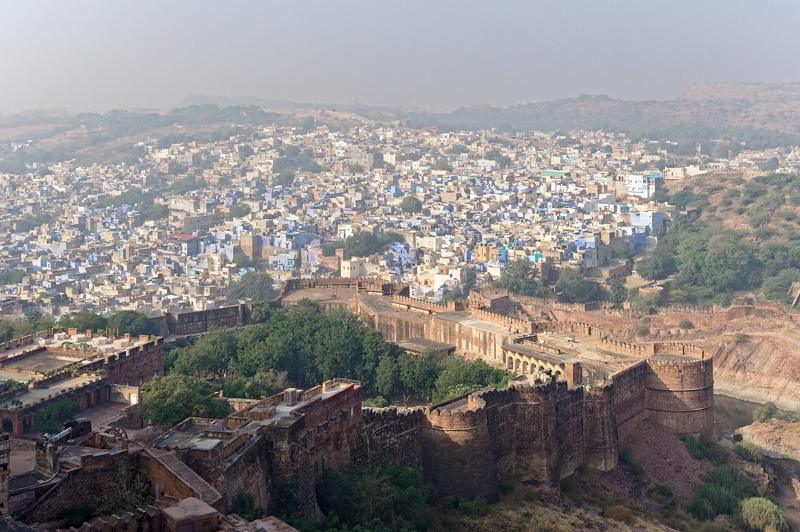
  • It is the most physically imposing building on the whole route, including the Taj Mahal, and it works on other terms: cliff and wall rising 120 metres over the old city, begun in 1459, never taken by assault, and still owned by the Jodhpur royal family, so the interiors are original and not rebuilt.
  • Late afternoon is the right light on that sandstone.
Day7

Jodhpur, blue lanes and the Bishnoi villages

Spend the morning below the fort, not inside it again.

  • The lanes under Mehrangarh are painted blue, once as a mark of Brahmin households and now as the look of Jodhpur, and they are cool and quiet before ten.
  • Sardar Market and the clock tower are a working market in the morning and a souvenir strip by four, so timing matters here more than anywhere else on the route.
  • The afternoon goes out of town.
  • A jeep run into the Thar scrub around the Bishnoi villages is the honest version of a desert day from Jodhpur.
  • The Bishnoi have protected trees and wildlife as a religious practice since the fifteenth century.
  • You meet potters and block-printers who are truly working, and you may see blackbuck in the open.
  • Go late in the afternoon, not at noon, for the animals and for the light.
Day8

Jaisalmer, the golden fort and a night in the dunes

Drive: about five hours

The drive from Jodhpur to Jaisalmer is about five hours, and the last two are the emptiest road of the trip.

  • Leave at seven and you reach the hotel around lunchtime, with the afternoon and evening free, which this day needs.
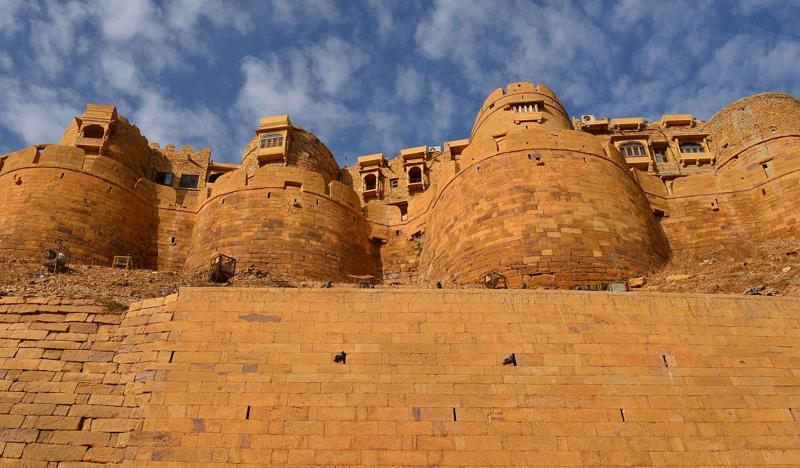
  • Jaisalmer Fort differs from every other fort on this route because people still live in it, around two thousand of them, within a twelfth-century citadel of yellow sandstone that turns gold in low light.
  • Inside the walls are houses, shops, fifteenth-century Jain temples and lanes barely wide enough for a motorbike.
  • Walk it in the late afternoon with your guide, and visit the merchant mansions of Patwon Ki Haveli below the fort if time allows.
  • Then the desert.
  • Camel and jeep runs go out to the dunes near Sam and Khuri in the late afternoon and end with dinner and Rajasthani folk music under open sky.
  • To be clear about it: the main dune area in high season is busy and the folk show is a show.
  • The desert itself, once the light fades and the day visitors leave, is not.
  • If you can, sleep out there instead of driving back to town, and choose a camp a little farther from the busiest cluster.
Day9

The long transfer south to Udaipur

Drive: nine to ten hours

This is the day Jaisalmer costs you.

  • Expect nine to ten hours by road from Jaisalmer to Udaipur, back through Pokhran and Pali, with no useful flight and no fast rail link.
  • Leave at six.
  • Lunch is taken on the road.
  • You reach Udaipur in the late afternoon.
  • Take something from the morning before you go.
  • A heritage walk through the fort lanes at first light, before the shops open and while residents are the only people about, is the best hour Jaisalmer has.
  • It costs an hour of the drive instead of a whole morning.
  • Then get in the car.
  • Udaipur comes as a surprise after the desert: water, hills and a city built around Lake Pichola.
  • See nothing tonight.
  • Walk to the ghats for the last light and have dinner in view of the palace.
Day10

Udaipur, slowly, and then home

Udaipur is where the route is meant to end.

  • After nine days of forts, marble and roads, it is the one place where doing less is the point, and the day is built around water rather than monuments.
  • Start early on the ghats while the city is washing.
  • The City Palace opens at nine and deserves the morning.
  • It is not one building but four centuries of them, added by successive maharanas along the eastern shore of Lake Pichola, with a museum, courtyards, mirrored rooms and terraces over the lake.
  • Afterwards walk through the old town to Jagdish Temple, a seventeenth-century shrine still in daily use, reached up a flight of steps that keeps most of the crowd away.
  • Finish on the water.
  • The last boat of the day on Lake Pichola passes the Lake Palace and stops at Jag Mandir island, and for most travellers it is the hour they remember.
  • Flights are not included in your tour.
Practical

Things worth knowing

The Friday rule, and how to count your days

The Taj Mahal is closed every Friday, all day, for prayers at the mosque inside the complex. There is no shorter opening. On this route you see it at sunrise on Day 4, so count four days forward from your arrival date before you book anything.

If Day 4 falls on a Friday, move your arrival by a day. If your flights are fixed, turn the Agra half around: visit the Taj on the Thursday afternoon you reach Agra, then use Friday morning for Agra Fort and Itimad-ud-Daulah before driving on. The afternoon light is harsher and the crowds heavier, but you see the building.

Moving between cities by car

One car and one driver stay with you from Delhi to Udaipur. Nothing is negotiated leg by leg in the middle of your holiday, and the driver knows where to stop. Fatehpur Sikri, for example, has no railway station and is the best stop on the road from Agra to Jaipur.

The legs run: Delhi to Agra, three to three and a half hours; Agra to Jaipur, with Fatehpur Sikri on the way; Jaipur to Jodhpur, five and a half to six hours; Jodhpur to Jaisalmer, about five; Jaisalmer to Udaipur, nine to ten. A fast train exists between Delhi and Agra, but this plan does not depend on it. Jaisalmer has a small airport with seasonal service that does not reach Udaipur. Udaipur has direct flights to Delhi and Mumbai for the journey home. Flights are not included.

The Jaisalmer problem, and the alternative order

Run as above, the itinerary asks for a nine to ten hour drive on Day 9. It is the classic sequence, because it puts the calmest city last and lets you fly home from Udaipur.

If the driving matters more to you than the shape, there is a cleaner order: Delhi, Agra, Jaipur, Udaipur, Jodhpur, Jaisalmer, then home from Jaisalmer or Jodhpur through Delhi. Jaipur to Udaipur is six to seven hours by road or an hour by air, Udaipur to Jodhpur is about five, Jodhpur to Jaisalmer about five. Total driving falls by roughly five hours and no day exceeds seven. You give up ending somewhere restful, and you accept a domestic connection home.

When to go

October to March is the season. From April the desert passes 45 degrees Celsius, and May and June are unsafe for walking around forts at midday. July to September is the monsoon, which is greener and cooler but unpredictable enough that a road day can double in length.

Choosing your hotel category

We arrange hotels by category, not by name: five-star city hotels, or heritage palace and fort properties. A modern five-star suits Delhi and Agra, and heritage stays suit Jaipur, Jodhpur, Jaisalmer and Udaipur. Rates are available on request once we know your dates.

Questions

Good to know

Is ten days enough to see India?
It is enough to see one region properly, and no more. Ten days covers Delhi, Agra, Jaipur, Jodhpur, Jaisalmer and Udaipur at a workable pace. It does not reach Varanasi, Kerala or the Himalaya, and a plan promising north and south in ten days is describing flights, not places.
Which day is the Taj Mahal closed?
Every Friday, all day, for prayers at the mosque inside the complex. This itinerary visits at sunrise on Day 4, so count four days forward from your arrival date. If it falls on a Friday, shift your arrival by a day, or see the Taj on Thursday afternoon and use Friday morning for Agra Fort, the Baby Taj and Mehtab Bagh.
Is Jaisalmer worth the driving?
That depends on what you want from the trip. It is the only living fort in India and the only true desert on this route. The cost is Day 9, with nine to ten hours in a car. If you would rather not give up a day, nine days ending in Jodhpur and Udaipur is the gentler plan.
How do we get from Jaisalmer to Udaipur?
By road, in nine to ten hours via Pokhran and Pali, with your own car and driver. There is no direct flight. You can break the journey with a night in Jodhpur, which makes two five-hour days, or reorder the itinerary so Udaipur comes before Jodhpur.
Should we sleep in a desert camp near Jaisalmer?
Yes, if you choose one away from the busiest dune cluster. The nearest camps in high season can feel like a car park with tents and a folk show. A little farther out you find real quiet and a clear sky. Either way, the camel or jeep run goes out in the late afternoon.
What is the best time of year for this route?
October to March. From April the western desert passes 45 degrees Celsius, and July to September is the monsoon. Within the season, Delhi's air is at its poorest from November to January, so February and March suit anyone with asthma. Desert nights in December and January are cold.
Do we need to arrange trains or hire a separate car for each leg?
No. You travel with one private car and driver from Delhi to Udaipur, and a licensed guide meets you in each city. A fast train between Delhi and Agra exists, but the plan does not rely on it. That also lets you stop at places like Fatehpur Sikri, which no train reaches.
How far ahead should we plan this trip?
It helps to plan ahead for the season from November to February, when hotels with lake or fort views and desert camps are in demand. Once your dates are set, we arrange the car, guides and hotel categories around the Friday closure. Flights are not included, so check them against the Day 4 Taj date.
Journeys

Take it privately

Rates on request

Tell us when you are travelling.

A short message is enough. We will come back with a plan, personally.

Enquire
WhatsApp
Plan your journeyWhatsApp